Use Cases
DPS4HPC addresses the most common reproducibility and data management challenges in computational research environments.
How It Works
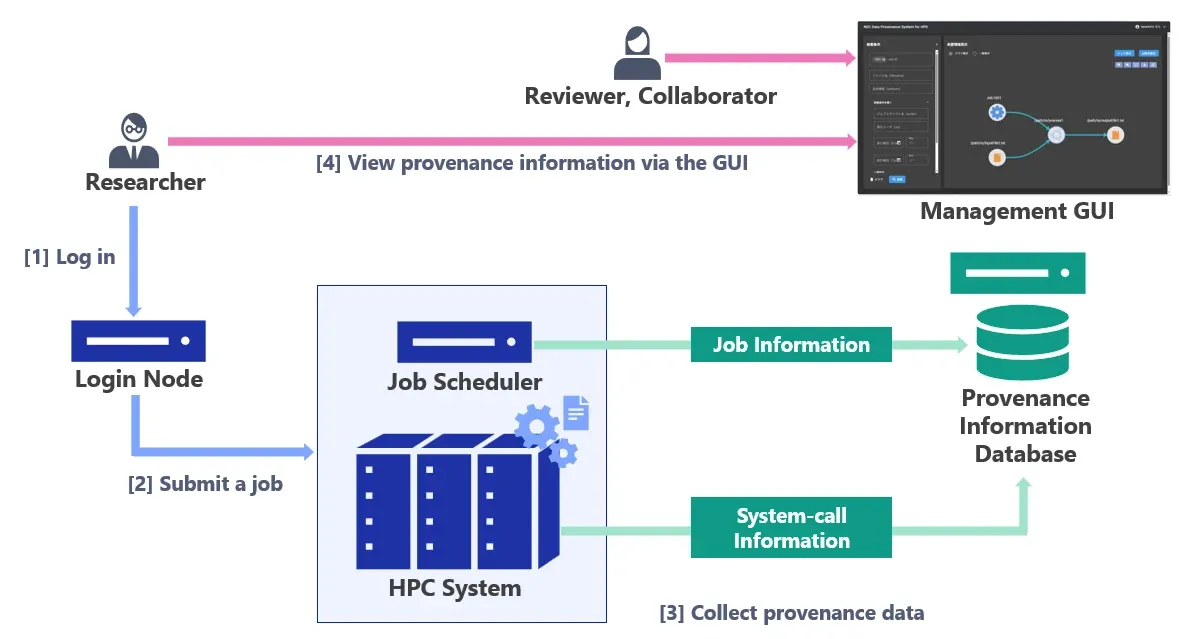
DPS4HPC fits into your existing HPC workflow without any changes. Users simply log in and submit jobs as usual — the system captures provenance automatically in the background.
Features
DPS4HPC captures, stores, and visualizes provenance information automatically — without requiring any modification to how researchers run their jobs.
Zero-Effort Provenance Capture
- Users log in and run jobs as usual — no changes to job scripts or applications required
- The system automatically captures job-level information and file relationships in the background
Comprehensive Job-Level Recording
- Integrates with major job schedulers including SLURM, PBS Pro, and NQS V to capture job metadata alongside system-level provenance
- Consistently records the relationships between input data, computational processes, and output data
Search and Visualize Provenance Data
- Web-based management GUI enables easy access, visualization, and sharing of provenance information
- Search provenance records by job ID, filename, user ID, execution time, and more
- Relationships visualized as an interactive provenance graph
Reproducibility and Collaboration
- Provenance information can be shared with reviewers and collaborators via GUI
- Supports open science and FAIR data principles — making research Findable, Accessible, Interoperable, and Reusable
* FAIR (Findable, Accessible, Interoperable, Reusable) is a set of guiding principles for research data management, widely adopted by funding bodies and research institutions worldwide.
Architecture
DPS4HPC consists of the following components, working together with your job scheduler to capture, store, and visualize provenance information.